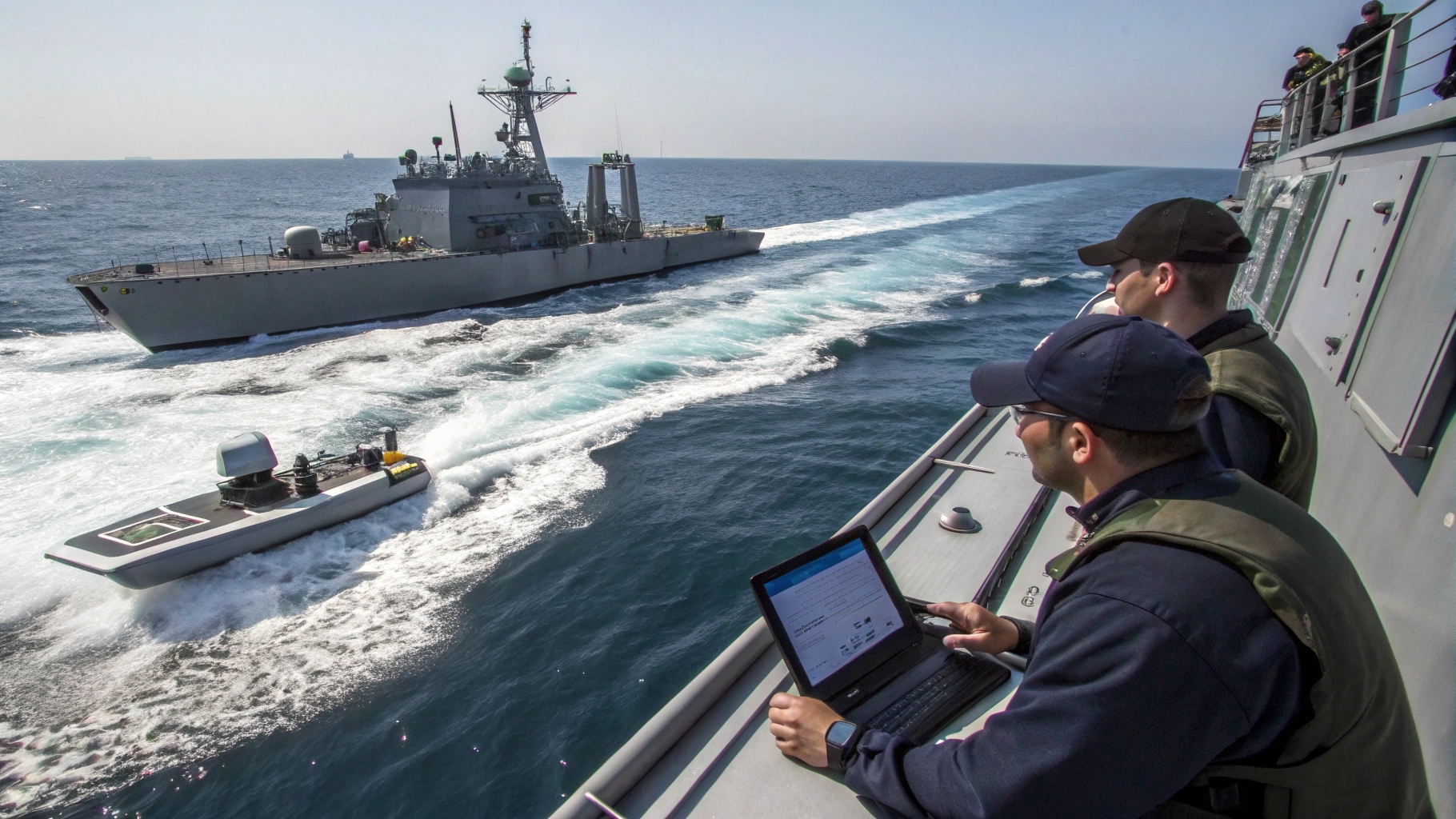
The Spanish Navy has taken delivery of its first unmanned surface vessel (USV), marking a major step toward manned–unmanned teaming and the integration of autonomous systems into fleet operations. The induction signals Spain’s entry into the growing use of unmanned maritime platforms for surveillance and support missions.
The new Sead 23 USV has been assigned to the CEVENTA experimentation and evaluation unit, headquartered at Naval Base Rota in southern Spain. Purpose-built as an unmanned maritime platform, the vessel is designed to conduct a wide range of missions, including patrol and escort duties, maritime surveillance, target detection and tracking, coastal reconnaissance, and seabed survey operations.
The platform was developed by Spanish company Seadrone, a subsidiary of the Zelenza Group, under a €1.1 million contract awarded in November 2024. Measuring 7 meters in length, the Sead 23 features a 2.32-meter beam, a shallow 57-centimeter draft, and a 600-kilogram payload capacity, allowing it to carry fuel along with mission sensors and effectors.
Its modular architecture supports the integration of satellite communications, advanced sensor suites, and mission payloads, including remote weapon stations and loitering munitions. Built from fiberglass, the USV is powered by a 320-horsepower diesel engine coupled to a waterjet propulsion system, enabling speeds of up to 36 knots.
At low-speed operations of 4 knots, the vessel can remain at sea for up to one week, providing extended endurance for persistent surveillance missions. The Sead 23 enhances operational flexibility by performing high-risk tasks that reduce personnel exposure and support amphibious operations, mine countermeasures, and stand-off threat detection.