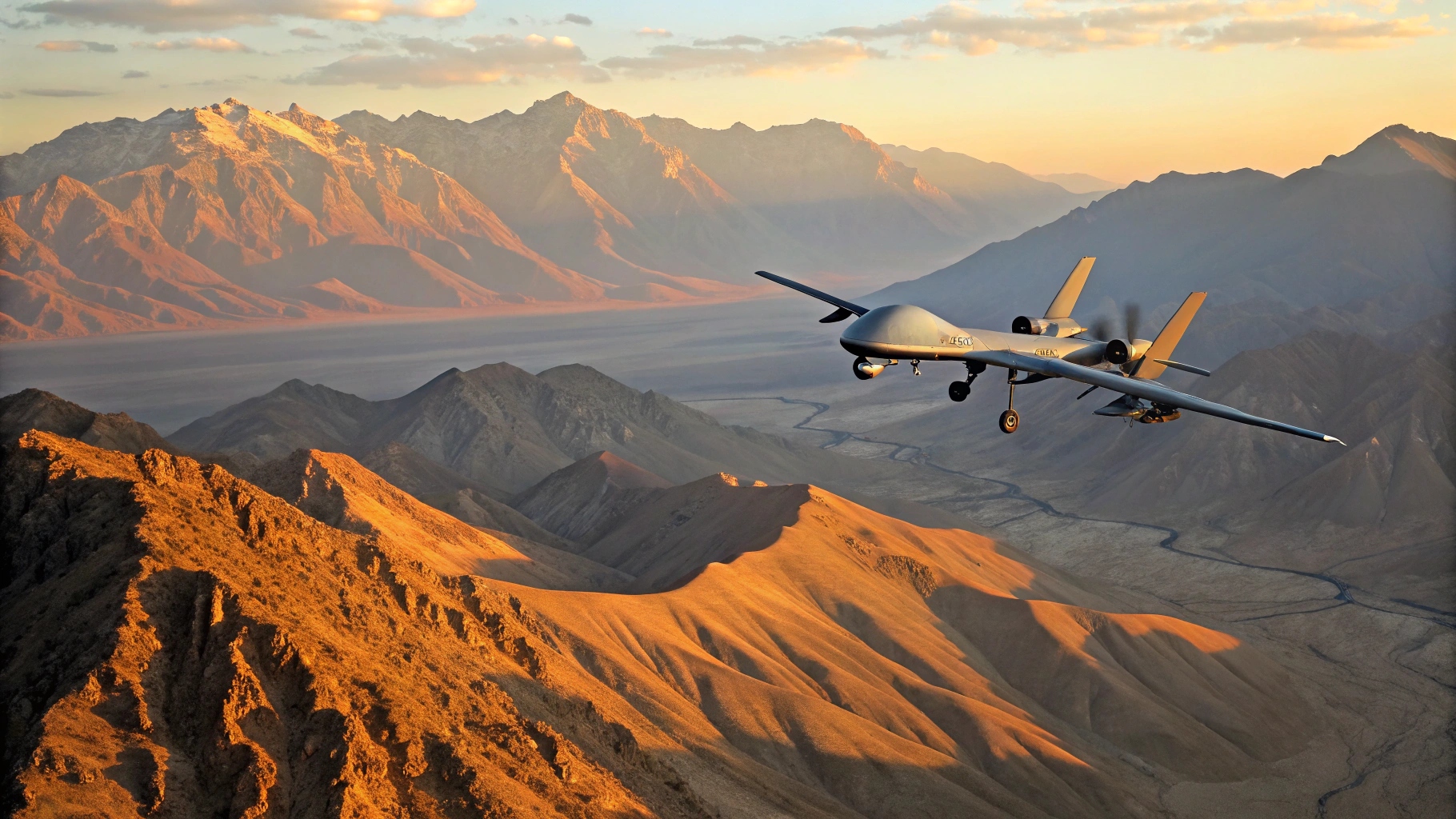
The MQ-9B SeaGuardian is the maritime variant of General Atomics Aeronautical Systems’ MQ-9B remotely piloted aircraft family. Developed from the MQ-9B SkyGuardian, it combines a long-endurance airframe with specialised maritime sensors to provide persistent intelligence, surveillance and reconnaissance across extensive ocean areas. Designed for military and civilian operators, the aircraft supports maritime domain awareness, search and rescue, disaster-response assessments and vessel tracking. An optional acoustic-surveillance package also enables underwater monitoring. India has become one of the programme’s significant operators. The Indian Navy began operating two contractor-owned SeaGuardian aircraft on lease in 2020, gaining experience in long-endurance maritime surveillance across the Indian Ocean Region. This operational exposure established the aircraft as an important asset for maritime security and monitoring missions. A major milestone followed in October 2024, when India finalised the acquisition of 31 MQ-9B aircraft. The order includes 15 SeaGuardians for the Indian Navy and 16 SkyGuardians for the Indian Army and Indian Air Force, reflecting a tri-service approach to long-range intelligence, surveillance and reconnaissance. Deliveries under the acquisition remained pending as of November 2026. In August 2026, the Ministry of Defence signed a separate 30-month lease agreement for two additional SeaGuardian aircraft, allowing the armed forces to maintain operational experience while preparing for the larger fleet. The SeaGuardian can be configured for maritime patrol, intelligence gathering, anti-submarine warfare, anti-surface warfare, airborne mine countermeasures and search-and-rescue missions. Its extended endurance allows commanders to maintain surveillance over strategically important sea lanes and maritime approaches. The aircraft features nine external hardpoints, comprising eight wing stations and one centreline station, alongside an internal payload bay. Depending on customer requirements and integration choices, it can carry Mk 54 lightweight torpedoes, AGM-114 Hellfire missiles, precision-guided munitions and sonobuoy dispensing systems capable of deploying up to 40 A-size or 80 G-size sonobuoys. Its sensor suite can include a 360-degree maritime surveillance radar, high-definition electro-optical and infrared sensors, Automatic Identification System receivers and electronic support measures. These systems allow operators to track vessel movements, identify contacts and maintain situational awareness over large maritime areas. Optional anti-submarine warfare packages support underwater detection and tracking through networked sonobuoy operations. Survivability and operational flexibility are supported by lightning protection, de-icing equipment and a Detect and Avoid capability that enables integration into civilian and NATO-controlled airspace. The aircraft was developed with airworthiness certification requirements in mind, distinguishing it from many earlier uncrewed aircraft types. Its digital architecture supports beyond-line-of-sight missions through satellite communications, Link 16 tactical networking, automatic take-off and landing functions and sonobuoy management systems. These capabilities enable cooperation with crewed platforms such as the P-8I Poseidon and naval surface combatants, forming a connected surveillance and reconnaissance network. The SeaGuardian uses a runway-operated configuration with a long-span wing, V-tail and rear-mounted pusher propeller. It measures 11.7 metres in length, has a wingspan of 24 metres and is powered by a Honeywell TPE331-10 turboprop engine. Its fatigue- and damage-tolerant airframe has a projected service life of 40,000 flight hours. The aircraft can operate above 40,000 feet, reach speeds of up to 210 knots true airspeed, remain airborne for more than 30 hours and cover distances exceeding 5,000 nautical miles, depending on mission configuration. Its maximum external payload capacity is 2,155 kg, supplemented by an internal payload capacity of 363 kg. Mission equipment varies according to customer requirements. The baseline maritime configuration combines radar, electro-optical and infrared imaging systems and AIS receivers. Optional equipment includes signals-intelligence packages, electronic support measures, airborne early-warning systems and communications-relay equipment. Although the SeaGuardian is not supplied with standard armament, India’s wider MQ-9B acquisition included AGM-114R Hellfire missiles. The exact weapons configuration of the Indian Navy’s SeaGuardian fleet has not been publicly confirmed. The aircraft originated from the MQ-9B development programme, initially known as the Type-Certifiable Predator-B. The development aircraft first flew in November 2016, while the first production-representative SkyGuardian flew in March 2020. SeaGuardian emerged as the maritime adaptation, incorporating removable maritime mission systems while retaining the common MQ-9B airframe. General Atomics demonstrated its maritime capabilities through open-water trials off Southern California and additional validation flights. Further demonstrations involved European air forces, while later testing included sonobuoy dispensing and advanced maritime surveillance missions. The MQ-9B family has expanded into several configurations. SkyGuardian serves as the baseline intelligence, surveillance and reconnaissance platform, while SeaGuardian focuses on maritime operations. The United Kingdom’s Protector RG Mk1 is a national derivative now serving with the Royal Air Force. Canada’s CQ-9B Guardian is based on the SkyGuardian configuration, while an MQ-9B Short Take-Off and Landing variant remains under development. The family has also expanded into an Airborne Early Warning configuration developed jointly with Saab, incorporating radar-based airborne surveillance capabilities. For India, the programme offers benefits across all three services. The Navy gains persistent surveillance across the Indian Ocean Region, supporting earlier detection of suspicious vessels, submarines and emerging threats. The Army can use SkyGuardian aircraft for long-endurance border surveillance, target acquisition and reconnaissance over remote sectors. The Air Force gains an intelligence-gathering platform for strategic monitoring, network-centric operations and joint-force coordination. Together, these capabilities can support real-time information sharing, improved situational awareness and faster responses across land, air and maritime domains. The MQ-9B family combines endurance, advanced sensors, networking and multi-mission adaptability, strengthening India’s ability to monitor and safeguard its strategic interests across a vast geographical area.